
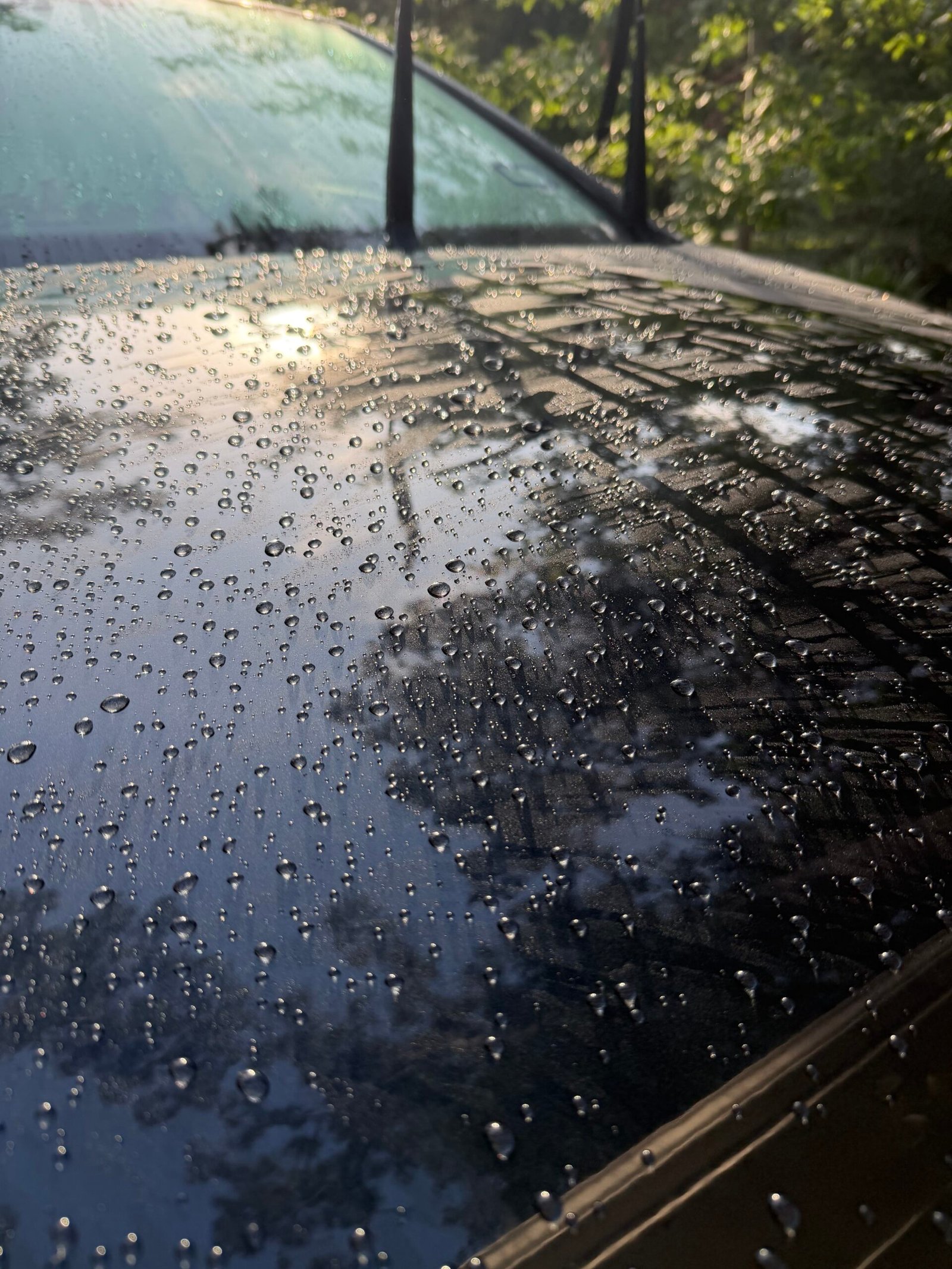
You park after a rainy drive, then return to find rings on the hood, streaks down the doors, and a dull layer around the rear bumper. The car got thoroughly wet. Why doesn’t it look clean?
Water spots after rain on car paint can come from residue left as droplets dry. Meanwhile, wet-road spray can add grime to surfaces that were already dusty. Rain may rinse away some loose dirt, but it does not replace a careful wash.
For drivers in The Woodlands and surrounding North Houston communities, the useful question is what remains after the rain—and whether ordinary cleaning takes care of it.
Why a Car Can Look Dirtier After Rain
Rain meets whatever is already on your vehicle: dust, settled pollen, and residue from everyday driving. Water can move that material into streaks or gather it around droplets before drying.
Airborne particles can contribute, too. The National Weather Service explains that rain removes particulate matter from the air, including dust and particles associated with vehicle emissions. That helps explain how rainfall can carry material onto surfaces; it does not establish the contents of any particular local storm. National Weather Service guidance
Driving adds another source of dirt. On a wet I-45 commute or a trip along Rayford Road, spray from tires brings roadway water onto the vehicle. That water can carry ordinary road grime.
A vehicle parked outside and one driven through traffic may therefore look different after the same shower. Neither appearance, by itself, tells you that the paint is damaged.
Water Spots and Road Film Are Different Problems
What drivers call water spots after rain on car paint
“Water spots” often describes small rings, pale outlines, or scattered marks where droplets dried. It is a description of appearance, not a diagnosis.
Gtechniq’s care guidance explains that evaporation can leave dissolved material behind. Mineral-containing hose or sprinkler water is a familiar source of deposits, but a mark noticed after rain should not automatically be labeled hard-water etching. Dirt already on the panel may also be involved. Gtechniq’s water-spot guide
Start by seeing what a proper wash removes. A remaining mark needs assessment before anyone can say whether it is surface residue or a change in the finish.
What road film looks like
Road film is the thin, dull or greasy-looking layer associated with traffic grime. Unlike separate droplet outlines, it may make a larger area look hazy or uneven.
Wet-road spray can distribute that grime along lower doors, behind wheels, and across the rear. Ordinary dirt may appear as obvious mud splashes or dusty streaks alongside it. Meguiar’s detailing guide identifies the sills, areas behind wheels, and rear among the places that commonly need extra cleaning attention. Meguiar’s detailing guide
These categories can overlap. One panel can carry loose dirt, droplet residue, and a broader film at the same time.
When the issue may need closer inspection
Persistent marks, rough contamination, or dullness after washing justify a closer look. Meguiar’s recommends inspecting paint after washing and drying to distinguish remaining contamination from other finish concerns. Meguiar’s paint-care FAQs
Describe what remains and where it appears. Avoid trying to identify damage by scraping a spot or repeatedly rubbing it. An inspection can help establish realistic options; detailing cannot be assumed to correct every mark.
What to Do After Driving in the Rain
A sensible car-care routine after rain starts with safe conditions and ends with inspecting a clean surface.
- Let unsafe weather pass. Stay sheltered during lightning or dangerous conditions. Cosmetic spotting does not justify working outside during a storm.
- Inspect in good lighting. Look at the hood, roof, doors, lower panels, rear, and glass. Notice whether you see isolated spots, mud, or a widespread film. You do not need to rub the paint to make this first check.
- Wash when the vehicle is genuinely dirty. Rinse loose dirt away, then use a proper vehicle wash. Rainwater on a gritty panel is not a substitute for cleaning solution. A complete wash removes contamination before drying; a dry towel simply moves across whatever remains.
- Choose shade and cool panels. Allow hot bodywork to cool. Meguiar’s recommends washing and drying in shade on a cool surface to help avoid spotting. Meguiar’s washing advice
- Use clean supplies and vehicle-safe soap. Follow the shampoo’s dilution instructions, rinse your wash mitt frequently, and work from cleaner upper surfaces toward dirtier areas. Keep wheel-cleaning tools separate from paint-care tools. Meguiar’s wash guidance supports working in sections with a clean microfiber mitt; Autoglym explains why wheel grime should stay out of bodywork wash water. Meguiar’s wash guide, Autoglym’s wheel-care guidance
- Rinse thoroughly and dry the clean vehicle. Use clean microfiber drying towels before mineral-containing rinse water evaporates. Replace a towel that becomes dirty. Autoglym recommends drying promptly after rinsing to reduce streaks and spotting. Autoglym’s washing and drying guidance
- Assess stubborn marks separately. Use only an automotive product approved for the affected surface, following its label, or seek professional assessment. Matte paint, wraps, and other special finishes require their own care instructions. Do not assume a product intended for glossy paint suits every surface. Meguiar’s finish-care guidance
If the car looks clean after this routine and no troublesome residue remains, a maintenance wash may be all it needs.
Mistakes That Can Make the Finish Look Worse
Small changes in technique can prevent avoidable frustration:
- Dry-wiping dusty or gritty paint: Loose contamination can be dragged across the finish. Clean the surface before drying it.
- Washing hot panels in direct sun: Products and water may dry before you can rinse or remove them.
- Using dirty towels or wash media: A towel that has collected grit belongs out of the paint-care process.
- Allowing soap or rinse water to dry: Work in manageable sections and rinse thoroughly.
- Scrubbing stubborn marks aggressively: Stop when normal washing is not resolving the issue. More pressure is not a diagnosis.
These precautions follow the clean-tool, cool-surface, and gentle-washing principles in Autoglym’s practical care guidance.
Two assumptions also cause trouble: believing protection makes washing unnecessary, and treating every spot as permanent damage. Neither helps you choose the right next step. Judge the finish after careful cleaning.
How Paint Protection Helps—and What It Cannot Do
Paint protection may help the finish resist ordinary contamination and make subsequent washing easier. Autoglym includes applying protection among its recommendations for easier future cleaning. Autoglym’s maintenance guidance
It cannot stop rain, dirt, or road spray from reaching the vehicle. Protected paint still needs washing, and droplets can still leave residue when they dry.
Pete’s currently includes a six-month paint sealant with Exterior Detail and Full Detail + Protection. Actual durability varies with storage, mileage, weather exposure, and washing habits. Six months is not a guarantee under every condition.
The guide to mobile detailing in The Woodlands explains the current exterior services and protection. The listed sealant should not be described as ceramic-coating installation.
When an Exterior Detail May Make Sense
Let the vehicle’s condition guide the decision. An exterior detail may be useful when:
- The finish remains dull after a proper wash.
- Spots or residue persist.
- Lower panels and wheels retain heavy road film.
- Existing protection appears to be losing performance.
- You want the exterior cleaned and its protection refreshed.
Persistent spotting deserves discussion before service. Do not assume that specialized spot removal or paint correction is included in a standard exterior package.
Pete’s owner-operated Exterior Detail currently includes a careful hand wash, wheel and tire cleaning, exterior glass, professional tire shine, and six-month paint protection. The final price is determined and agreed upon in person before work begins, based on actual vehicle size and condition.
The mobile detailing service areas include suitable addresses around The Woodlands, Spring, the Rayford Road corridor, and Kingwood. Suitability depends on the exact address, safe workspace, vehicle access, a working water hose, a standard electrical outlet, property rules, travel, and routing.
Frequently Asked Questions
Does rainwater wash dirt off a car?
It can rinse away some loose dirt. It does not reliably remove accumulated grime, and driving on wet roads can add fresh contamination.
Are all water spots permanent?
No. Some are surface deposits or residue. Marks that remain after washing need assessment; their appearance alone does not prove permanent damage.
Should I wipe my car down immediately after rain?
Avoid wiping dusty or gritty paint with a dry towel. Let unsafe weather pass, inspect the vehicle, and wash it when dirty. Dry clean surfaces with clean microfiber towels.
Can water spots form on a protected vehicle?
Yes. Protection does not prevent water or contamination from reaching the surface. Washing and careful drying still matter.
When should I ask a detailer to inspect the finish?
When spots, rough contamination, or dullness remain after proper washing—or when you are unsure which product is appropriate. Explain what cleaning you have already tried.
Does Pete’s install ceramic coatings?
Pete’s current website lists six-month paint sealant and does not list ceramic-coating installation.
Keep Your Vehicle Easier to Maintain After Wet Weather
After rain, inspect first, wash away dirt safely, and dry the clean vehicle. If that restores a clean appearance, routine maintenance may be enough. Persistent residue calls for assessment before more aggressive treatment.
If spotting or road film remains after a proper wash, review Pete’s exterior detailing options and request an available detailing date. Service-location suitability is confirmed from the exact address, workspace, water and power access, property rules, and route.
Leave a Reply